The Miraculous Language of the Qur'an
THIS study illustrates why the Qur’an’s language is miraculous, unique, and evidence of its divine authority. The author compares Qur’anic language with the language of pre-Islamic poetry, the Prophet’s words (Hadith), and the language of the Arabs both past and present, to demonstrate that although the Qur’an was revealed in classical Arabic it was at the same time an Arabic which was entirely new. Original and early Muslim audiences viewed this as miraculous and responded to the Qur'an's words, sounds, rhythms etc. in a manner consistent with a deeper appreciation of its beauty and majesty which modern ears, trained by familiarity, and despite being surrounded by all manner of dictionaries and studies, are at a loss to capture. The author attempts to remove this veil and present the Qur’an to readers as if hearing it for the first time, to bring to life something of this wonder. In doing so he guides readers to appreciate the beauty of the Qur’an, to become more immersed in it, and have a clearer understanding of its structure and flow. Devoting special attention to Surah al-Muddaththir (chapter 74) to underpin his analysis, Saeh thus brings the Revelation to life, to demonstrate that each surah has distinct features and characteristics that make it stand out uniquely within the design and sweep of the whole.
Of course we can only examine the Qur’an as far as our own limited intellects allow. Even the best tools of human literary analysis could not possibly do justice to what has incredibly come to man from God. Differentiating Qur’anic language from human ingenuity is another way of clearly stating that even the most gifted orators, and those exceptionally talented in the arts of literature and poetry, could not produce a single surah “like unto it” (10:38). This confident Qur’anic assertion to prove its statement false is not only a wholly intellectual appeal and an open challenge to critics, but also fantastic by the sheer simplicity with which it presents this greatest of challenges.
Product Information
Product Information
Shipping & Returns
Shipping & Returns
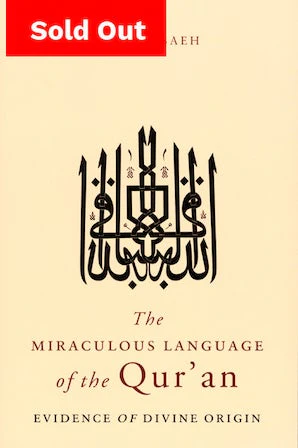
The Miraculous Language of the Qur'an
The Miraculous Language of the Qur'an
THIS study illustrates why the Qur’an’s language is miraculous, unique, and evidence of its divine authority. The author compares Qur’anic language with the language of pre-Islamic poetry, the Prophet’s words (Hadith), and the language of the Arabs both past and present, to demonstrate that although the Qur’an was revealed in classical Arabic it was at the same time an Arabic which was entirely new. Original and early Muslim audiences viewed this as miraculous and responded to the Qur'an's words, sounds, rhythms etc. in a manner consistent with a deeper appreciation of its beauty and majesty which modern ears, trained by familiarity, and despite being surrounded by all manner of dictionaries and studies, are at a loss to capture. The author attempts to remove this veil and present the Qur’an to readers as if hearing it for the first time, to bring to life something of this wonder. In doing so he guides readers to appreciate the beauty of the Qur’an, to become more immersed in it, and have a clearer understanding of its structure and flow. Devoting special attention to Surah al-Muddaththir (chapter 74) to underpin his analysis, Saeh thus brings the Revelation to life, to demonstrate that each surah has distinct features and characteristics that make it stand out uniquely within the design and sweep of the whole.
Of course we can only examine the Qur’an as far as our own limited intellects allow. Even the best tools of human literary analysis could not possibly do justice to what has incredibly come to man from God. Differentiating Qur’anic language from human ingenuity is another way of clearly stating that even the most gifted orators, and those exceptionally talented in the arts of literature and poetry, could not produce a single surah “like unto it” (10:38). This confident Qur’anic assertion to prove its statement false is not only a wholly intellectual appeal and an open challenge to critics, but also fantastic by the sheer simplicity with which it presents this greatest of challenges.
$2.40
Original: $8.01
-70%The Miraculous Language of the Qur'an—
$8.01
$2.40Product Information
Product Information
Shipping & Returns
Shipping & Returns
Description
THIS study illustrates why the Qur’an’s language is miraculous, unique, and evidence of its divine authority. The author compares Qur’anic language with the language of pre-Islamic poetry, the Prophet’s words (Hadith), and the language of the Arabs both past and present, to demonstrate that although the Qur’an was revealed in classical Arabic it was at the same time an Arabic which was entirely new. Original and early Muslim audiences viewed this as miraculous and responded to the Qur'an's words, sounds, rhythms etc. in a manner consistent with a deeper appreciation of its beauty and majesty which modern ears, trained by familiarity, and despite being surrounded by all manner of dictionaries and studies, are at a loss to capture. The author attempts to remove this veil and present the Qur’an to readers as if hearing it for the first time, to bring to life something of this wonder. In doing so he guides readers to appreciate the beauty of the Qur’an, to become more immersed in it, and have a clearer understanding of its structure and flow. Devoting special attention to Surah al-Muddaththir (chapter 74) to underpin his analysis, Saeh thus brings the Revelation to life, to demonstrate that each surah has distinct features and characteristics that make it stand out uniquely within the design and sweep of the whole.
Of course we can only examine the Qur’an as far as our own limited intellects allow. Even the best tools of human literary analysis could not possibly do justice to what has incredibly come to man from God. Differentiating Qur’anic language from human ingenuity is another way of clearly stating that even the most gifted orators, and those exceptionally talented in the arts of literature and poetry, could not produce a single surah “like unto it” (10:38). This confident Qur’anic assertion to prove its statement false is not only a wholly intellectual appeal and an open challenge to critics, but also fantastic by the sheer simplicity with which it presents this greatest of challenges.


